
Project Octopus

TL;DR: A living body becomes a world where Self (Octopus), Shadow (Cthulhu), and life itself (the Battlefield) coexist and continually shape one another. There is no final victory or perfect harmony—only consequence, memory, learning, adaptation, repair, cooperation, and change. The tattoo ends not by solving the system, but by accepting a dynamic equilibrium stable enough for life to continue.
Storyboard Gallery | skip to detailed descriptions |
The Details
This project transforms a three-part inspiration—Octopus, Battlefield, and Cthulhu—into a single large-scale tattoo across a living human back, shoulders, and upper arms.
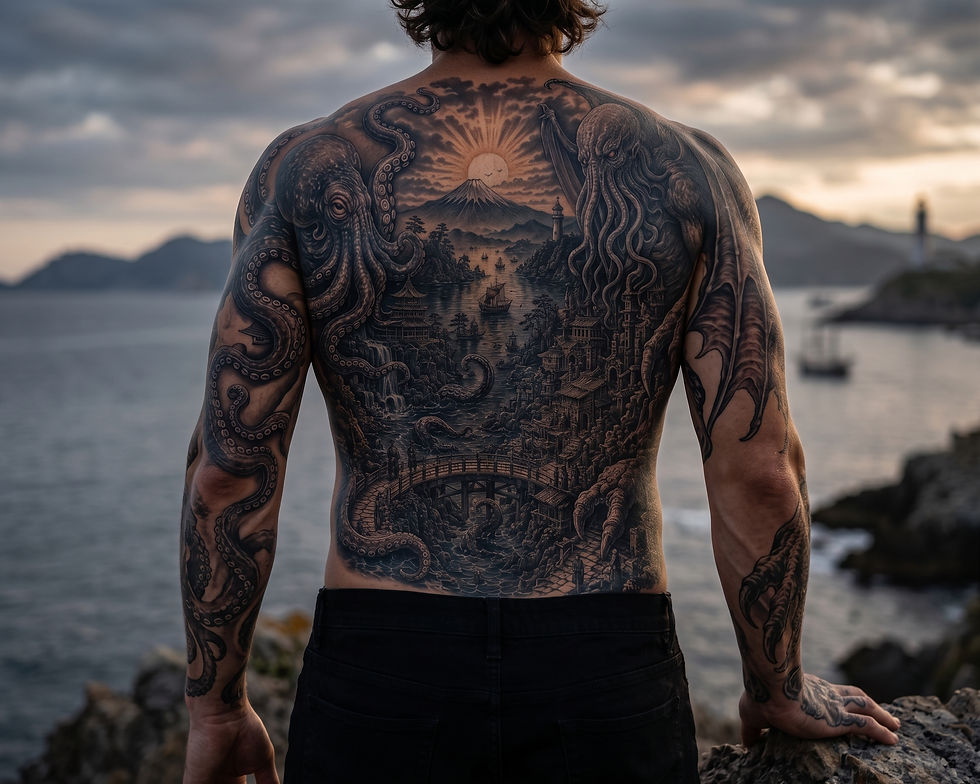
The Octopus represents Self: curiosity, adaptability, intelligence, agency, and consequence. Cthulhu represents Shadow: the powerful, difficult, mysterious, creative and destructive capacities that also belong to the whole. Between them lies the Battlefield—the World: not the place where Self and Shadow fight, but the field in which the consequences of living accumulate. Fuji, sun, water, bridge, temple, lighthouse, settlements, boats, people, vegetation, ruins, scars, and repairs show a world containing beauty and wreckage, cooperation and disruption, loss and renewal. Equilibrium means dynamic balance, not perfection.
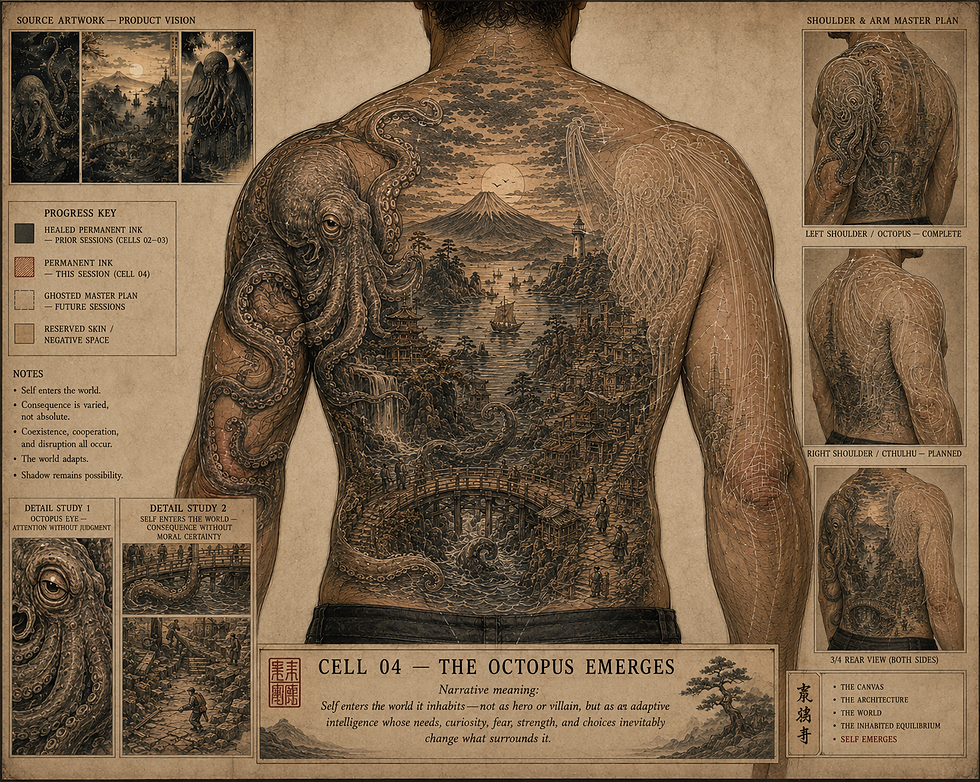
The ten-cell storyboard tells how that idea becomes embodied. Cell 00, The Living Canvas, begins with the body itself: anatomy, movement, skin, curvature, and negative space establish the first constraints. Cell 01, The Architecture, maps Self, Shadow, and World onto that living geometry. Cell 02, The World Takes Form, establishes the central landscape before either protagonist dominates it. Cell 03, The Inhabited Equilibrium, gives that world people, ordinary life, history, damage, repair, and cooperation. Cell 04, The Octopus Emerges, introduces Self into the already-living world, where its actions inevitably create consequences. Cell 05, The Shadow Emerges, gives Shadow equal permanence without turning the composition into good-versus-evil combat.
Cell 06, Incursion, changes the system: boundaries become permeable and consequences propagate among Self, Shadow, inhabitants, and World. Cell 07, Accommodation, introduces the decisive new property—memory changes subsequent behavior. Scars remain, repairs improve, routes change, restraint develops, and cooperation can occur without friendship, surrender, or loss of identity. Cell 08, One World, synthesizes these relationships into a single continuous composition: distinct identities remain, but the original triptych boundaries disappear.
The tattoo is now complete in composition, but not in consequence. Finally, Cell 09, The Healed Equilibrium, subjects the finished work to reality—healing, movement, anatomy, pigment settling, negative space, and viewing distance—and applies the closing discipline: inspect → selectively finish → preserve → close. What works is protected; only evidence-supported weaknesses justify intervention; perfection is explicitly rejected.
The accompanying Battlefield call-out artwork provides the interpretive key. Cherry blossoms signify impermanence; Fuji endurance; the sun continuity and possibility; birds perspective; the lighthouse guidance without certainty; temple reflection; waterfalls release and renewal; ruins consequence and memory; bridges transition; boats adaptability; ships exploration and risk; people community and cooperation; and sea life depth and complexity. None is a simple moral symbol. Together they describe a world in which destruction and creation are intertwined, every cycle leaves traces, and adaptation matters more than victory.
So the entire storyboard can be reduced to one progression:
Body → Architecture → World → Life → Self → Shadow → Interdependence → Learning → Integration → Acceptance.
And its central proposition is equally compact:
A life worth living is not produced by eliminating conflict, uncertainty, Shadow, damage, or change. It emerges through continuing interaction with them—acting, experiencing consequences, remembering, learning, adapting, cooperating when possible, repairing what matters, preserving what works, and knowing when to stop.
The finished tattoo therefore does not depict a victory. It depicts a living equilibrium.
Source Artwork — Octopus and CthulhuThis paired image establishes the original visual and conceptual polarity from which the body-art project developed. On the left, a naturalistic octopus moves through an underwater environment. Its body is soft, fluid, decentralized, and extraordinarily adaptable; its arms explore in multiple directions while remaining parts of a single organism. On the right, Cthulhu rises monumentally from a ruined maritime landscape. Its geometry is almost the inverse: massive, vertical, architectural, ancient, and difficult to comprehend. Wings, claws, stone, turbulent water, and ruined structures give it a sense of permanence and formidable latent power.Importantly, the source image does not depict the two figures fighting. They occupy separate panels and separate worlds. That separation became one of the central design problems explored by the tattoo. How it inspired the body-art designThe two figures provided the project's principal symbolic anchors: Octopus as Self and Cthulhu as Shadow. But rather than reproducing the source artwork as two opposing illustrations, the body-art design asks what happens when these different presences must inhabit the same living system. The human anatomy supplied the answer. The Octopus naturally belongs to one shoulder, scapula, and upper arm, where its tentacles can follow muscular curvature and wrap around the deltoid. Cthulhu occupies the opposing shoulder and arm, where wings, torso, claws, and vertical forms can follow a different anatomical geometry. The back between them becomes the World—the Battlefield of consequence. That transformation is crucial. The source artwork supplies two protagonists; the tattoo project supplies the relationship between them. The central Japanese landscape—Fuji, sun, water, bridge, settlements, temple, lighthouse, boats, vegetation, ruins, and inhabitants—therefore became much more than decorative connective tissue. It establishes a world that exists before either Self or Shadow fully enters it. Beauty, ordinary life, cooperation, damage, repair, and continuity have their own standing. The Battlefield is consequently not where Octopus and Cthulhu conduct a conventional war. It is the world altered by everything that happens within it. From inspiration to storyboard architectureThe original two-panel artwork also explains why the storyboard begins by preserving separation and then progressively dissolves it. Early cells establish the body, composition, and World before making either protagonist permanent. The Octopus then emerges as Self; Cthulhu follows as Shadow. Only afterward are their consequences allowed to propagate across their original territories. This produces the narrative progression: Living Canvas → Architecture → World → Inhabited Equilibrium → Self → Shadow → Incursion → Accommodation → One World → Healed Equilibrium. The source image's hard vertical division is therefore something the finished tattoo deliberately outgrows. Tentacles enter waterways and architecture; Shadow-associated forms participate in the landscape; vegetation, clouds, water, ruins, paths, and human activity cross former boundaries. Eventually there are no independent left, center, and right illustrations. There is one composition wrapped around one living body. The contrast between the source figures nevertheless remains valuable. The design never requires Self to become Shadow or Shadow to become Self. The Octopus retains its organic fluidity and adaptive intelligence; Cthulhu retains its weight, mystery, power, and capacity for disruption. Integration does not require loss of identity. That became perhaps the most important development from the original inspiration: what began visually as two extraordinary creatures placed beside one another evolved into a study of Self, Shadow, World, consequence, memory, learning, accommodation, and dynamic equilibrium. The source artwork gave the project its vocabulary. The body-art design turned that vocabulary into a living system. |
 |
The middle panel establishes the Battlefield—the World in which consequence becomes visible. Framed by cherry blossoms, Mount Fuji, the returning sun, temple, lighthouse, waterfalls, ruins, bridge, boats, settlement, people, and the first incursions of sea life, it depicts neither paradise nor a conventional battleground, but a dynamic equilibrium in which beauty and wreckage, order and uncertainty, cooperation and disruption coexist. Life continues through change: people travel, build, repair, adapt, remember, and begin again. No single element defines the meaning of the landscape; meaning emerges from their relationships over time. The accompanying call-out study identifies these elements and their symbolic roles, revealing the Battlefield not as the fight itself, but as the world the continuing interaction of Self, Shadow, others, and circumstance shapes. |
 |
The Center Panel Call-Outs |
 |
00 - Before there is an image, there is a body. The back, shoulders, scapulae, upper arms, and changing curves of muscle establish the living surface the work must inhabit. Anatomical landmarks define opportunities and constraints, while reserved skin and negative space remain active parts of the design. Nothing has yet been committed to finished imagery. This first state establishes the essential premise of the project: the body is not a blank rectangular canvas but a moving, three-dimensional substrate to which every later decision must adapt. |
 |
01 - The available surface becomes a compositional architecture. The Octopus/Self takes its place across the left shoulder and arm, Cthulhu/Shadow occupies the right, and the Battlefield/World develops between them across the back. Major forms are registered to the spine, scapulae, shoulders, and muscular flow rather than imposed as separate rectangular pictures. Hierarchy and proportion are established, but much remains provisional. This stage determines where the principal relationships can develop while deliberately preserving enough visual and physical capacity for the composition to change as it grows. |
 |
02 - The central World becomes tangible before its principal symbolic presences are made permanent. Sun, Mount Fuji, water, coastline, sky, and major landscape masses establish distance, movement, continuity, and scale. The result is not yet primarily a landscape of conflict or consequence; it is first a place possessing beauty and coherence of its own. Establishing the World before Self and Shadow matters because later disruption will occur within something already worth inhabiting, preserving, repairing, and returning to. The Battlefield begins, therefore, with the existence of a world. |
 |
03 - The World is no longer merely scenery: it is inhabited. Bridges, settlements, temple, lighthouse, boats, vegetation, ruins, and people reveal ordinary life unfolding amid both beauty and evidence of earlier disturbance. Some things endure, some are damaged, some are repaired, and others are adapted around. Cooperation and continued activity coexist with wreckage rather than eliminating it. Here, equilibrium acquires its governing meaning—not perfection or stillness, but a dynamic condition in which sufficient coherence persists for people, structures, ecosystems, and relationships to continue. |
 |
04 - The Octopus enters permanence as Self: a living intelligence characterized by curiosity, adaptability, capability, appetite, and embodied action. It does not enter an empty stage; it enters the already-inhabited World. Its presence therefore changes conditions. Tentacles encounter water, structures, paths, and other features, producing consequences that may be useful, disruptive, damaging, or simply different from what existed before. Self is neither hero nor villain. This cell establishes something more fundamental: to possess agency is inevitably to affect the world one inhabits, including in ways that cannot be completely predicted. |
 |
05 - Cthulhu enters permanence as Shadow: powerful, difficult to interpret, and capable of fear, protection, disruption, creation, and consequence. Shadow is not introduced as Self's enemy, nor as an evil force awaiting defeat. It is another enduring presence within the larger system, retaining its own nature while affecting the same inhabited World. With both Self and Shadow now present, the composition gains its principal actors without declaring a war between them. Life continues between and around both, absorbing their effects and preserving the unresolved possibility of what their coexistence may eventually produce. |
 |
06 - Boundaries that once separated Self, Shadow, and World become increasingly permeable. Tentacles, water, vegetation, architecture, ruins, pathways, and atmospheric movement cross former territories, while actions originating in one region produce effects elsewhere. The important change is not invasion but interdependence: the World acts upon Self and Shadow just as they act upon it, and the consequences of one may reach the other indirectly through their shared environment. No final relationship has been established. Instead, Cell 06 reveals the unavoidable systems condition beneath the composition: none of its participants can now act entirely in isolation. |
 |
07 - Repeated experience begins to alter what happens next. Scars remain, but repairs become more informed; routes change, structures adapt, materials are reused, and recurring interactions produce restraint and different choices. Self, Shadow, inhabitants, and World have not become alike, nor have their tensions disappeared. What has changed is behavior. The system now carries memory of previous consequences, and that memory influences subsequent action. Accommodation therefore represents learning rather than surrender: distinct participants discover ways to coexist more effectively with realities they cannot eliminate, making cooperation possible without requiring friendship, domination, or permanent harmony. |
 |
08 - What began as distinct territories now reads as a single continuous composition. Self, Shadow, inhabitants, landscape, water, architecture, scars, repairs, and accumulated adaptations belong to one interconnected World, carried across the anatomy by shared atmosphere, movement, value, and negative space. Their identities have not disappeared; rather, their relationships have matured enough that separation is no longer the organizing principle. Nothing has finally “won,” and consequence has not ended. The tattoo is now complete in composition, not in consequence: one living system has emerged from many different forces without requiring those forces to become the same. |
 |
09 - The completed composition now encounters reality. After healing, it is judged on moving skin, across anatomical curves and viewing distances, with pigment settled and negative space performing its intended work. The question is no longer what else can be added, but what the evidence actually justifies changing. Small weaknesses may receive selective finishing; successful irregularities, softened transitions, scars, and breathing room are deliberately preserved. The governing discipline becomes inspect → selectively finish → preserve → close. The tattoo-production project ends not with perfection, but with a realized artifact stable enough to continue its life with the wearer. |
 |
About the Creator
Fellow Traveler is a systems thinker, transformation leader, and lifelong technologist whose work explores how people and complex systems respond to uncertainty, consequence, feedback, and change. Drawing on decades of experience in software engineering, Lean-Agile transformation, architecture, and organizational learning, he is particularly interested in the patterns connecting human behavior with adaptive systems.
His work frequently explores Self and Shadow, complexity, dynamic equilibrium, learning, adaptation, and emergence—not as abstract ideals, but as processes revealed through lived experience.
This tattoo project translates those ideas into a living visual system. Rather than depicting a battle between good and evil, it explores what happens when different forces must inhabit the same world: they act, create consequences, remember, adapt, repair, cooperate, and continue. The human body is not simply the surface carrying that story; it is part of the story itself.
AI Role in this Project AI served as a collaborative design, visualization, and configuration-management tool, not as the source of the project's intent. The human creator supplied the central concepts—Octopus as Self, Cthulhu as Shadow, the Battlefield as the World of consequence—along with the symbolism, aesthetic direction, constraints, and final judgment. AI helped translate those ideas into images, explore alternatives, identify inconsistencies, and maintain continuity across the storyboard.
The process was deliberately iterative. AI-generated possibilities were examined rather than automatically accepted. Drift was corrected; useful emergent discoveries—such as the importance of memory, learning, accommodation, negative space, and restraint—were incorporated through human judgment.
As the project matured, AI's role shifted from generation to review and configuration control: preserving what worked, challenging unnecessary additions, and helping determine when the design was complete.
The result is best understood as human-directed, AI-augmented creativity. AI expanded the possibility space and accelerated exploration; human experience, meaning, judgment, focus, and direction governed what ultimately became the work.

Comments