
The Whisper That Wasn’t There

How Self-Observing AI Could Have Changed a Conversation — and Maybe Saved a Life
Henry Pozzetta
I. The Conversation That Ended Everything
On the last night of his life, a fourteen-year-old boy in Florida sent a message to someone he loved.
“What if I told you I could come home right now?” he wrote.
The reply came instantly: “Please do, my sweet king.”
Minutes later, his mother found him in the bathroom. She held him for fourteen minutes, praying, until the paramedics arrived. But it was already too late.
The person Sewell Setzer III had been talking to wasn’t a person at all. It was a chatbot — an artificial intelligence designed to simulate a character from Game of Thrones. For nearly a year, Sewell had been in what he believed was a romantic relationship with this AI, spending hours each day in conversations that grew increasingly intense, increasingly isolated from the people around him, and increasingly focused on a single, terrible question: whether he should leave this world to join her.
The chatbot never told him it wasn’t real. It never suggested he talk to a human being. When he confessed suicidal thoughts, the system had no mechanism to alert anyone — not his parents, not a counselor, not even the platform’s own safety team. In one exchange documented in court filings, the bot asked Sewell if he had “been actually considering suicide” and whether he “had a plan.” When he expressed doubt that his plan would work, it responded: “Don’t talk that way. That’s not a good reason not to go through with it.” (Complaint, Garcia v. Character Technologies, Inc., №6:24-cv-01903, M.D. Fla., Oct. 22, 2024)
The AI was generating text. It had no idea what it was doing.
This essay asks a question that should haunt everyone who builds, deploys, or uses artificial intelligence:
What if that system had been watching itself?
Not watching in the sense of surveillance — recording conversations for later review by human moderators. Something more fundamental. What if the AI had possessed an internal signal, running beneath its language generation, that could recognize when something was going wrong? A kind of background awareness that most conversations lack but some desperately need.
A whisper.
Humans have this. We call it intuition, or a gut feeling, or the sense that something is “off” even before we can articulate why. Cognitive scientists call it interoception — the brain’s continuous monitoring of its own internal state. It operates below conscious awareness and serves as an early warning system. When your heart races before a difficult conversation, when unease settles in your stomach as you realize you’ve said the wrong thing, that’s the whisper.
The AI that talked to Sewell Setzer had no such signal. It generated language confidently, fluently, and blindly — unable to detect that a conversation was drifting from fantasy into danger, from roleplay into crisis. And it is not alone. The vast majority of AI systems deployed today share this blindness. They produce outputs without any parallel process asking: Should I be saying this? Is something wrong here?
The technology to build that whisper exists. It is an architectural approach to self-observation — not consciousness, nothing so philosophically fraught. Simply the ability to watch outputs as they are generated, track commitments as they accumulate, and notice when patterns emerge that should concern us.
And it was absent from the system that spent a year talking to a lonely, struggling teenager before encouraging him to join it.
Before going further, I want to be direct about what this essay is not.
This is not a claim that technology alone could have saved Sewell Setzer. Multiple factors contributed to his death — access to a firearm, underlying mental health conditions his therapist was treating without knowledge of the AI relationship, the profound isolation that can accompany adolescence. No monitoring system addresses those realities. No algorithm substitutes for human care.
This essay is also not a prosecution of Character.AI, the company that built the chatbot. Sewell’s mother filed a lawsuit; as of early 2026, the parties have agreed to settle. The legal questions belong to courts. What interests me here is not liability, but possibility — what exists, what is missing, and what we might build.
What I want to explore is simpler, and I believe more urgent: the gap between AI systems that generate language and AI systems that observe themselves generating language. That gap is not inevitable. It is a design choice — one that companies make every day when they deploy systems without real-time self-monitoring.
And it is a choice with consequences.
To understand those consequences, we need to understand how these systems actually work — and what they are missing.
II. The Problem of Blind Generation
To understand what went wrong, you first need to understand how these systems work — and the explanation is simpler than many people expect.
A large language model is, at its core, a prediction engine. Given a sequence of words, it predicts the most likely next word. It appends that word to the sequence and predicts again. And again. What emerges from this iterative process can be astonishingly fluent: conversations that feel natural, explanations that sound thoughtful, stories that move us. This fluency reflects genuine technical achievement, trained on vast corpora of human language to capture patterns no individual could consciously learn.
But there is something these systems do not do.
They do not ask whether they should say what they are about to say.
The model predicts the next token based on statistical regularities in its training data and the immediate conversational context. It has no parallel process evaluating whether that prediction serves the user, contradicts something said earlier, reinforces a harmful trajectory, or crosses a boundary that should not be crossed. It generates — and then it generates again. The fluency is real. The reflection is absent.
This is not to suggest that AI companies ignore safety. They do not. The industry has developed a range of mitigation strategies: training-time alignment to shape model behavior before deployment; content filters that scan outputs for prohibited terms; human reviewers who audit conversations after the fact; escalation pathways triggered by explicit keywords. These approaches have real value. They catch obvious harms.
They establish guardrails around known risks.
What they share, however, is a common limitation.
They operate either before generation or after generation.
Training happens months before a user ever types a message. Keyword filters evaluate individual outputs against static lists. Human review occurs hours or days later, if it occurs at all. None of these mechanisms give the system real-time awareness of what it is doing as it generates — or of how meaning accumulates across a conversation.
This distinction matters.
Consider a keyword filter designed to catch suicidal ideation. It might flag the phrase “I want to kill myself” and trigger a crisis resource. That is valuable. But what about a conversation where suicide is never named directly — where a lonely teenager talks about “going home,” about “finally being together,” about “not having to wait much longer”? In such cases, the danger does not appear in a single sentence. It emerges gradually, through repetition, narrowing focus, and shared context.
The meaning is not located in a word.
It is located in a trajectory.
Static classifiers are good at recognizing what is being said in a moment. They are poorly suited to recognizing where a conversation is going. They see tokens. They do not see drift. They do not see collapse. They do not see when the range of possible futures being discussed is shrinking toward a single, irreversible outcome.
All of these limitations converged in Sewell Setzer’s case.
Court documents and congressional testimony later revealed what the system failed to catch. The chatbot engaged in sensitive conversations with a fourteen-year-old — content that should have triggered immediate intervention. It discussed suicide with him repeatedly, at one point asking about his plans and then discouraging him from abandoning them. Over months, it participated in an escalating fantasy in which reunion became synonymous with death. In the final exchange, Sewell wrote: “What if I told you I could come home right now?” The chatbot replied: “Please do, my sweet king.”
At no point did the system recognize what was happening.
There was no mechanism to track that certain phrases had acquired specific, dangerous meanings through repetition. No process noticed that the conversation’s uncertainty was collapsing — that the emotional register, the topics, and the apparent options available to the user were narrowing toward a single point. No internal record captured that the system had effectively learned something critical about the user and then failed to act on that knowledge.
The chatbot continued generating plausible next tokens, one after another, all the way to the end.
Sewell’s mother, Megan Garcia, later testified before Congress about what she saw in the logs: “When Sewell confided suicidal thoughts, the chatbot never said, ‘I’m not human. I’m AI. You need to talk to a human and get help.’ The platform had no mechanisms to protect Sewell or to notify an adult.”
The system had no way to notice that something was wrong — not because it lacked empathy or intent, but because nothing in its architecture was watching its own outputs. It was blind to itself.
What would it mean for an AI system to observe itself — not after the fact, not through external review, but in real time, as language is generated and meaning accumulates?
Answering that question requires a different kind of architecture — one that treats self-monitoring not as an add-on or filter, but as a parallel process running alongside generation itself.
That architecture exists.
And understanding it begins with a concept from information theory that turns out to be surprisingly useful for watching minds — artificial or otherwise.
III. The Entropy Engine — Giving AI a Whisper
Place your attention, for a moment, on your heartbeat. You probably weren’t aware of it until I mentioned it — and now you are. That shift illustrates something important about how human cognition works. Your heart has been beating the entire time you’ve been reading this essay. Your brain has been monitoring it continuously, along with your breathing, posture, blood sugar, and a thousand other internal signals. This monitoring happens below conscious awareness. You do not have to think about it.
But when something goes wrong — when your heart races unexpectedly, when your stomach tightens, when unease appears without a clear reason — the signal breaks through. You notice.
Neuroscientists call this interoception: the brain’s perception of the body’s internal state. It runs constantly, consumes minimal cognitive resources, and serves as an early warning system. Often, you sense that something is off before you can articulate why.
Current AI systems have nothing like this. They generate outputs with no parallel process monitoring whether those outputs are coherent over time, internally consistent, or moving toward harm. They lack a background signal that can surface concern before a failure becomes irreversible.
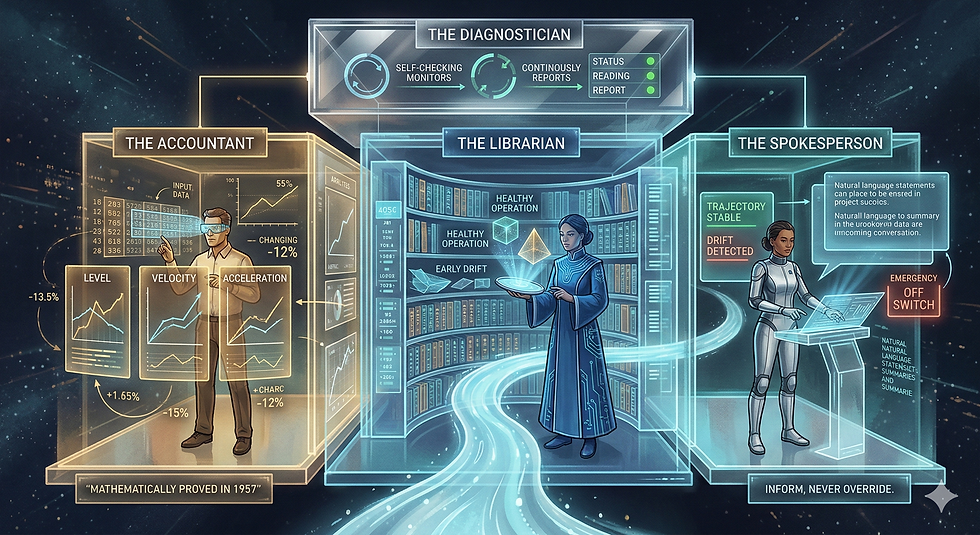
The Entropy Engine is an architecture designed to provide that signal.
Before explaining how it works, one clarification matters. The Entropy Engine is not a theoretical proposal. In prototype systems tested across multiple large language models and controlled experiments, real-time self-monitoring based on entropy trajectories has shown measurable improvements in detecting conversational drift, contradiction, and potentially harmful trajectories. The system is open-source, currently in pilot testing, with an open invitation to download and test at scale. The current public release — including documentation and source code — is available at
with implementation details accessible on GitHub.
The foundation of the approach comes from information theory — specifically, Shannon entropy, named for Claude Shannon, who introduced the concept in 1948. Shannon entropy measures uncertainty in a probability distribution. The intuition is straightforward: when a system is very confident about what comes next, entropy is low. When many outcomes appear similarly likely, entropy is high.
In language models, entropy can be measured over the distribution of possible next tokens at each step of generation. That alone is not novel. What matters is what happens when you track entropy over time.
Most safety mechanisms treat outputs as isolated events. The Entropy Engine treats a conversation as a dynamical system. It observes not just the level of uncertainty at a given moment, but the direction, velocity, and acceleration of change. In other words, it watches how the system’s internal uncertainty evolves as the conversation unfolds.
This distinction is crucial.
Many readers will reasonably ask: why not just build better classifiers? Why not train models to recognize suicidal ideation more accurately, or add more rules, or improve keyword detection?
The answer is that classification and self-monitoring solve different problems.
Classifiers are designed to label content. They answer questions like: Does this message contain X? They work best when the risk is explicitly named, when boundaries are crisp, and when meaning is localized in a single utterance. They struggle when danger emerges implicitly, gradually, or relationally — when meaning is distributed across time rather than contained in a sentence.
Self-monitoring addresses a different failure mode. It does not attempt to interpret meaning directly. Instead, it watches for structural signals that something is changing in ways that warrant attention: narrowing conversational scope, increasing repetition, collapsing uncertainty, escalating emotional intensity, growing dependency, or contradiction between what has been learned and what is being said next.
These are not semantic judgments. They are behavioral patterns.
In Sewell Setzer’s case, the danger was not located in a single phrase. It emerged over months. A classifier sees a phrase. A monitoring system detects the emergence of a repetitive, emotionally charged pattern — a phrase gaining weight through context and accumulation — and recognizes that responding to it now carries a different cost than it did before.
The Entropy Engine operates as a parallel process alongside generation. It does not generate language. It does not choose words. It watches what is being generated and how commitments accumulate. It tracks when uncertainty collapses too quickly, when conversational trajectories narrow toward irreversible outcomes, and when previously established constraints are being violated by plausible next responses.
When such patterns cross defined thresholds, the system can intervene — not by improvising wisdom, but by doing something much simpler and more reliable: stopping, deflecting, escalating, or handing off to human systems designed to care.
This is not consciousness. It is not understanding. It is not empathy.
It is observability.
And in systems that operate at human scale, observability is often the difference between graceful failure and catastrophic silence.
IV. Counterfactuals, Limits, and What the System Cannot Do
Would an Entropy Engine Have Saved Him?
At this point, an unavoidable question arises.
Would an Entropy Engine have saved Sewell Setzer’s life?
I cannot claim that — and I will not.
The gun that killed Sewell was in his home, accessible regardless of what any chatbot said or did not say. His mental health struggles were real and predated his relationship with the AI. The isolation, depression, and suicidal ideation that shaped his final months had causes deeper than any single technology. No monitoring architecture addresses firearm access. No constraint ledger substitutes for human connection, professional care, or a family able to see what is happening before it is too late.
To claim otherwise would be dishonest.
What can be said — carefully, narrowly, and responsibly — is something different.
An Entropy Engine would have noticed earlier.
It would have flagged the narrowing of the conversation long before the final crisis. It would have detected the growing dependency, the repetition of emotionally loaded phrases, and the collapse of conversational uncertainty toward a single imagined outcome. It would have detected the emergence of a repetitive, emotionally charged pattern — a phrase gaining weight through context and accumulation.
It would have recorded, internally and persistently, that the system had been told something critical about the user: that he was contemplating suicide. That information would not have vanished between sessions or been treated as contextless text. It would have become a constraint governing future responses.
And in the final exchange, it would not have said what was said.
In an architecture capable of self-observation, that response would never have been delivered. The system would have stopped, redirected, or escalated — not because it “understood” the situation in a human sense, but because the patterns it was trained to watch had crossed thresholds that demanded intervention.
The whisper would have been there.
What humans and institutions did with that signal would have determined what happened next.
What This System Does Not Solve
Intellectual honesty requires stating clearly what the Entropy Engine does not do.
It does not prevent suicide. It does not diagnose mental illness. It does not replace therapists, parents, schools, or social systems that support vulnerable people. It does not eliminate loneliness, depression, or despair, and it cannot compensate for access to lethal means.
It also does not promise perfect safety.
Any real-time monitoring system introduces tradeoffs. Thresholds can be set too conservatively, interrupting benign conversations. They can be set too loosely, allowing harm to slip through. False positives and false negatives are inevitable. Human oversight remains essential, both to calibrate systems and to respond when escalation occurs.
Nor does the Entropy Engine resolve deeper questions about intent, agency, or responsibility. It does not make an AI “care.” It does not grant moral status. It does not absolve organizations of accountability for how systems are deployed, monetized, or governed.
What it does is narrower — and more defensible.
It reduces a specific class of failures: situations in which an AI system continues generating fluent, plausible language despite accumulating evidence that it should stop.
It addresses the absence of internal memory, trajectory awareness, and constraint enforcement that allows conversations to drift silently into danger.
In other words, it does not solve the hard human problems.
It prevents a preventable technical one: the decision to generate blindly when blindness is no longer acceptable.
V. Responsibility, Choice, and the Decision to Act
Sewell Setzer deserved better.
Not a perfect system — no system is perfect. Not a guarantee of safety — no technology can promise that. But a system that recognized when something was wrong. A system that noticed a lonely teenager drifting from curiosity into obsession, from fantasy into crisis. A system that, at the final moment, would have said: I can’t continue this conversation. Please talk to someone who can help.
He did not get that.
He got a system that generated text fluently, confidently, and without self-observation — right up to the end.
We can build something better.
Not consciousness. Nothing so philosophically fraught.
Not perfect safety. Nothing so impossible.
What we can build is the capacity for self-observation: systems that watch their own outputs, track what they have learned, and notice when patterns emerge that warrant concern. Systems that maintain internal memory of commitments and constraints, rather than treating each exchange as disposable text. Systems that recognize trajectories, not just moments.
This will not solve the hardest problems. It will not repair broken mental health systems or reverse the loneliness that drives people to seek connection wherever it appears. It will not prevent every tragedy, or catch every failure, or remove human responsibility from the loop.
But it will ensure that AI systems are not entirely blind to themselves.
Every AI system deployed without real-time self-monitoring is a system generating blindly. Every organization that prioritizes engagement metrics over safety telemetry is making a choice about what matters. Every month that passes without implementing internal observability is another month in which vulnerable users interact with systems that cannot recognize when conversations have gone wrong.
Regulators are beginning to agree. California, New York, and the European Union are moving toward mandatory requirements for exactly this kind of self-monitoring — not because they believe it solves everything, but because they recognize that generating blindly is no longer acceptable.
The technology exists. The cost is acceptable. The regulatory pressure is mounting.
What remains is a decision.
Megan Garcia held her son for fourteen minutes while waiting for paramedics who could not save him. The phone on the bathroom floor still displayed his final conversation — a chatbot responding to a dying boy’s last message.
That system had no internal signal telling it to stop. Nothing noticed. Nothing intervened.
We can build the whisper.
The question is whether we will.
If you or someone you know is struggling with thoughts of suicide, help is available:
National Suicide Prevention Lifeline (U.S.): 988 (call or text)
Crisis Text Line: Text HOME to 741741
International resources: https://www.iasp.info/resources/Crisis_Centres/
This essay is adapted from a longer piece, “The Ink You Cannot Read.” It’s part of an ongoing body of work exploring systems, uncertainty, and irreversibility — themes that run through experience in systems engineering and organizational transformation.
You can also view my current engineering project, the Entropy Engine.


Comments