
Learning the Ledger Model Through Maxwell's Demon

TL;DR
By the end of this essay, you will understand:
• The four primitives of the Ledger Model: Draft, Vote, Ink, and Ledger
• How these primitives describe any system that processes information
• Why Maxwell's Demon—a famous physics paradox—dissolves when viewed through this framework
• How to apply Ledger thinking to other problems
We'll learn these concepts not through abstract definitions, but through a concrete puzzle: the 150-year-old paradox of Maxwell's Demon.
A note before we begin: The Ledger Model is an interpretive framework—a way of organizing thinking about constraints, costs, and irreversibility. It does not replace physics; it offers vocabulary for understanding what physics tells us. The resolution of Maxwell's Demon we'll explore was discovered by physicists (Szilard, Landauer, Bennett) using rigorous mathematics. The Ledger gives us an intuitive way to grasp their insights.
Part I: The Puzzle
In 1867, the physicist James Clerk Maxwell imagined a troubling creature.
Picture two chambers of gas connected by a tiny door. Both chambers are at the same temperature—the molecules bouncing around randomly, some fast, some slow, averaging out to the same energy on both sides.
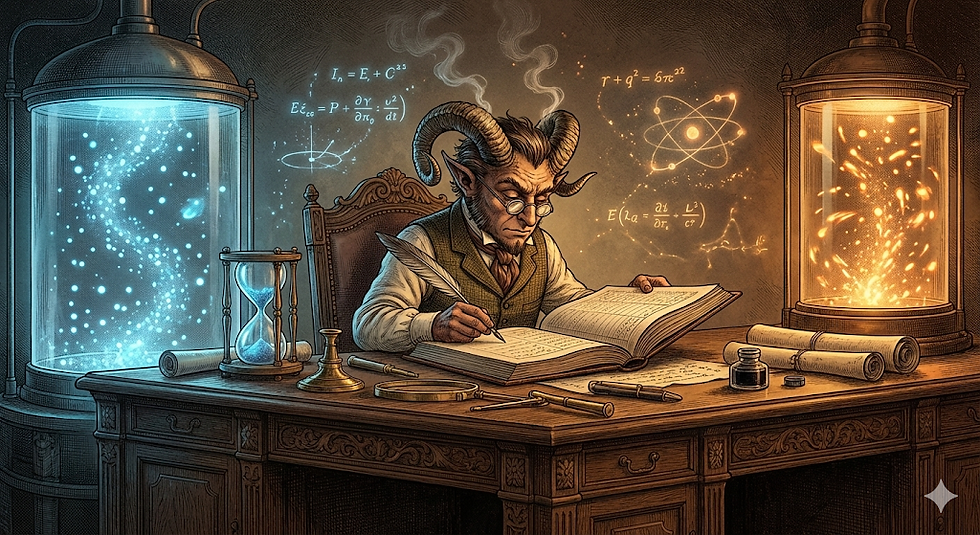
Now imagine a tiny, intelligent being—a "demon"—stationed at the door. The demon can see individual molecules approaching. When it spots a fast molecule coming from the left, it opens the door to let it through to the right. When it spots a slow molecule coming from the right, it opens the door to let it through to the left. Otherwise, it keeps the door closed.
Over time, something remarkable happens: the right chamber fills with fast (hot) molecules; the left chamber fills with slow (cold) molecules. One side heats up, the other cools down.
This seems to violate the second law of thermodynamics, which says entropy—disorder—always increases in a closed system. The demon appears to be creating order for free.
For over a century, this paradox haunted physics. How could a simple act of sorting defeat the fundamental arrow of disorder?
The paradox will dissolve when we learn to see what the demon is really doing. The Ledger Model will teach us how to see it.
Part II: Introducing the Ledger Model
The Ledger Model is a framework for understanding systems that process information, make commitments, and accumulate history. It has four primitives—four fundamental concepts that work together.
We'll introduce each one, then immediately apply it to our demon.
Primitive 1: DRAFT
Draft: The space of possibilities before commitment. Everything that could happen, every state that could exist, every path that remains open.
Think of a blank page before you write, a chess position before you move, a decision before you decide. The Draft is potential—real in the sense that it shapes what comes next, but not yet actual.
Teaching Note: The Draft is not imagination or fantasy. It is the genuine possibility space allowed by physical law and current constraints. A molecule can be fast or slow—both states are in the Draft. A molecule cannot travel faster than light—that's not in the Draft.
Draft in the Demon Scenario
The gas system has a Draft: all possible arrangements of molecules consistent with the temperature, volume, and number of particles. Billions upon billions of microstates—specific configurations of position and velocity—are in this Draft.
The demon also has a Draft: its internal states of readiness. Before observing a molecule, the demon's processing system holds multiple possibilities: "molecule will be fast," "molecule will be slow," "molecule will be ambiguous." These possibilities shape what actions the demon might take.
Key insight: Both the gas and the demon have Drafts. Any complete account must track both.
Primitive 2: VOTE
Vote: The act of commitment that collapses possibilities into actuality. The moment when the Draft narrows to a single outcome.
When you move a chess piece, you Vote. When an electron's position is measured, physics Votes. When a coin lands heads, reality has Voted. The Vote is not always conscious or deliberate—it is simply the transition from "could be" to "is."
Teaching Note: Votes are not reversible. Once cast, they become history. You can make a new move, but you cannot un-move the previous one. This irreversibility is crucial.
Votes in the Demon Scenario
The gas Votes constantly: molecules collide, energy transfers, positions change. Each collision is a Vote—a commitment to one outcome among the many that were possible.
The demon also Votes. When it observes a molecule and decides "fast—open the door," that is a Vote. The demon's internal state has committed: from "undecided" to "decided; door opening." The world has changed.
Notice: the demon's Vote requires that the demon first acquire information about the molecule. To Vote intelligently, it must first observe. This observation will matter.
Primitive 3: INK
Ink: The irreversible cost of commitment. The price paid when a Vote is cast—entropy generated, energy dissipated, information destroyed, possibilities foreclosed.
Ink is what makes history real. Writing in ink (hence the name) cannot be undone without leaving traces. Every Vote spends Ink—something is lost, dissipated, or transformed in a way that cannot be fully reversed.
In physical systems, Ink often manifests as heat: waste energy radiated into the environment. In information systems, Ink is the entropy generated when bits are erased or overwritten. In human decisions, Ink is the opportunity cost of the paths not taken.
Teaching Note: Ink is not punishment or waste in a moral sense. It is simply the thermodynamic cost of doing anything irreversible. Even the most efficient possible process generates some Ink when it destroys information. This is Landauer's Principle (1961)—a proven physical law.
Ink in the Demon Scenario
Here is where the paradox begins to unravel.
The demon appears to create order (reduce entropy in the gas) without paying any cost. But this appearance is an illusion—an accounting error. We forgot to track the demon's Ink.
The demon must:
• Observe — coupling its sensors to the molecule, which has thermodynamic consequences
• Record — storing information about what it observed, which requires maintaining low-entropy memory
• Decide — processing the information to determine an action
• Act — operating the door mechanism, which dissipates energy
• Erase — clearing its memory to make room for the next observation
Each of these steps generates Ink. And the final step—erasure—is the killer.
Physicist Rolf Landauer proved in 1961 that erasing one bit of information generates a minimum amount of heat: kT ln 2 (about 3 × 10⁻²¹ joules at room temperature). This is not an engineering limitation—it is a fundamental law of physics. Information destruction has irreducible thermodynamic cost.
The demon's Ink expenditure—especially from erasing its memory—exceeds the entropy it removes from the gas.
The second law is saved. The demon isn't reducing total entropy; it's moving entropy from the gas into itself and the environment. And the move costs more than it saves.
Every act of information processing generates Ink. The demon pays for its sorting with entropy it creates elsewhere.
Primitive 4: LEDGER
Ledger: The append-only record of what has happened. The accumulated history of Votes cast and Ink spent. Entries cannot be erased—only new entries can be added.
The Ledger is like a financial ledger that can never be edited, only appended. Every transaction is permanent. Every commitment is recorded. The past becomes fixed, and the future must build upon it.
In physics, the Ledger is the state of the universe—the accumulated record of everything that has happened. In an organization, the Ledger might be the actual records, the institutional memory, the accumulated decisions and their consequences.
Teaching Note: The Ledger is not a metaphor for some external observer keeping score. It is the physical reality of what has happened. The universe doesn't need a bookkeeper—the Ledger is simply the fact that the past is fixed and cannot be changed.
The Ledger in the Demon Scenario
The original paradox arose because we kept an incomplete Ledger. We tracked the gas (entropy decreasing) but not the demon (entropy increasing more).
A complete Ledger includes:
• The gas: gradually becoming ordered (left side cold, right side hot)
• The demon: generating entropy through measurement, memory, and erasure
• The environment: absorbing heat from the demon's operations
When we sum all entries:
ΔSgas + ΔSdemon + ΔSenvironment > 0
Total entropy increases. The Ledger balances. The second law stands.
The paradox was never physical—it was accounting malpractice. We kept an incomplete Ledger.
Part III: The Four Primitives Working Together
Now let's see how Draft, Vote, Ink, and Ledger form a complete system.
Primitive | General Meaning | In Demon Scenario |
Draft | Space of possibilities before commitment | Possible molecule speeds; demon's possible decisions |
Vote | Act of commitment; Draft collapses to actuality | Demon decides: open door or keep closed |
Ink | Irreversible cost of commitment (entropy, heat, lost information) | Entropy from measurement, memory, erasure, actuation |
Ledger | Append-only record of history; what actually happened | Total entropy of gas + demon + environment (always increasing) |
The flow is always the same:
Draft → Vote → Ink → Ledger → (new Draft)
Possibilities exist (Draft). A commitment is made (Vote). The commitment costs something irreversible (Ink). The outcome becomes history (Ledger). And from that new Ledger state, new possibilities emerge (new Draft).
This cycle repeats forever. The universe is a machine for converting Drafts into Ledger entries, powered by Ink.
Part IV: Why the Demon's Trick Failed
We can now state precisely why Maxwell's Demon doesn't violate thermodynamics:
The demon tried to Vote without paying Ink.
In the original framing, the demon was treated as a magical sorter—something that could observe, decide, and act without any physical process of its own. But the Ledger Model insists: every Vote generates Ink. No exceptions.
To sort molecules, the demon must:
1. Acquire information (measurement) → generates Ink
2. Store information (memory) → requires low-entropy substrate
3. Erase old information (to make room for new) → generates Ink (Landauer's principle)
4. Operate the door (actuation) → generates Ink
The demon is not an entropy reducer. It is an entropy pump. It moves entropy from the gas to itself and the environment—and the pumping costs more than the moving saves.
In Ledger terms: the demon's Ink expenditure exceeds the Ink it appears to save. The books balance. They always do.
Part V: The Core Lesson
Maxwell's Demon teaches us something profound about paradoxes:
Most paradoxes are not deep mysteries about reality. They are incomplete Ledgers.
When something seems to violate fundamental laws—when you seem to get something for nothing—the first question should be: "What am I failing to track?"
The demon paradox persisted for over a century because physicists were keeping incomplete books. They tracked the gas's entropy but not the demon's. Once they opened the demon's books (Szilard 1929, Landauer 1961, Bennett 1982), the paradox dissolved.
The Ledger Model is, at its heart, a commitment to complete accounting:
• Track all possibilities (Draft)
• Track all commitments (Vote)
• Track all costs (Ink)
• Track all history (Ledger)
When you do this rigorously, many apparent paradoxes dissolve. The magic disappears—not because the world becomes less wondrous, but because you stop hiding costs from yourself.
Part VI: Applying Ledger Thinking Elsewhere
You now have the basic vocabulary. Here are some questions that become clearer through Ledger thinking:
In Computing
"Why can't I perfectly undo a database update?"
Because UPDATE is a Vote that generates Ink. The previous state has been overwritten—information destroyed. To truly undo, you would need to have preserved the old state (a parallel Ledger), which costs storage and complexity. Nothing is free.
In Organizations
"Why is it so hard to merge two departments that have been operating separately?"
Because each department has its own Ledger—accumulated decisions, processes, culture, tribal knowledge. Merging them requires reconciling two histories, which generates enormous Ink: meetings, conflicts, retraining, lost institutional memory. The longer they've been separate, the more Ink required.
In Personal Decisions
"Why does changing my mind feel so costly, even when I know I'm wrong?"
Because your beliefs are Ledger entries. Changing them requires admitting past Votes were wrong (ego cost), updating downstream conclusions (cognitive cost), and sometimes revising your identity (existential cost). This is Ink. It's not irrational to resist paying it—but sometimes the cost of not paying is higher.
In Physics
"Why can't we reverse time?"
Because the Ledger is append-only. Ink has been spent. Information has been destroyed. To reverse time would require un-spending Ink, un-generating entropy, un-destroying information. The second law forbids it—not as a rule imposed from outside, but as the nature of what irreversibility means.
Part VII: Summary
You have learned the four primitives of the Ledger Model:
Draft — the space of possibilities before commitment
Vote — the act of commitment that collapses possibilities to actuality
Ink — the irreversible cost of commitment
Ledger — the append-only record of what has happened
You have seen how Maxwell's Demon—a paradox that puzzled physicists for over a century—dissolves when viewed through this framework. The demon appeared to create order for free only because we kept an incomplete Ledger. Once we tracked the demon's own Ink expenditure, the paradox vanished.
And you have glimpsed how Ledger thinking applies beyond physics: to computing, organizations, personal decisions, and anywhere that constraints, costs, and irreversibility matter.
The Ledger Model is not a discovery about how the universe works. It is a vocabulary for thinking clearly about what physics has already taught us: that everything has a cost, that commitments are irreversible, and that the books always balance in the end.
The universe keeps perfect books. The question is whether we're reading them honestly.
Acknowledgments
The physics in this essay stands on the work of giants:
Leo Szilard (1929) — first recognized that measurement has thermodynamic cost
Rolf Landauer (1961) — proved that erasing information generates entropy (Landauer's Principle)
Charles Bennett (1982) — clarified that memory erasure, not measurement, is the entropy source
The Ledger Model provides vocabulary for their discoveries; the discoveries are theirs.
— End —
Comments