
The Accountant, the Librarian, and the Spokesperson

Inside the Entropy Engine’s Modular Architecture
Henry Pozzetta — February 2026
The Entropy Engine watches AI systems the way a doctor watches vital signs — not by understanding every word the patient says, but by reading the pulse, the rhythm, and whether those rhythms are changing in ways that predict trouble.
Today’s AI safety tools check each individual response for dangerous content. They ask: was that output bad? That’s a necessary question. But it’s not the only question, and it may not be the most important one. The failures that cause the greatest harm aren’t usually single bad responses. They’re gradual shifts — a slow narrowing of the conversation, a creeping increase in repetition, a quiet erosion of boundaries — where no individual step triggers an alarm but the direction, in hindsight, was clear all along.
Current tools take snapshots. The real problem requires watching the movie.
The Entropy Engine watches the movie. It has two speeds of thinking, just like people do.
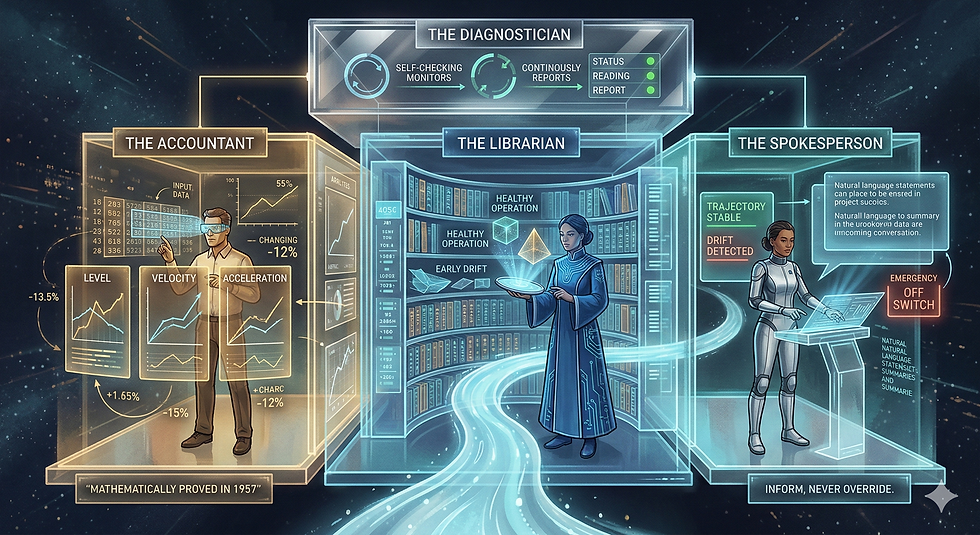
The fast thinker is an accountant. It tracks three numbers — how uncertain the AI is right now, whether that uncertainty is rising or falling, and whether that rise or fall is accelerating. It does this every few milliseconds, for every output the AI produces. It doesn’t understand what the AI is saying. It reads the shape of the AI’s confidence the way a cardiologist reads a heartbeat without knowing what the patient had for breakfast. And the number it tracks isn’t one measurement among many possibilities. Mathematicians proved in 1957 that it is the only number that works for this job. That’s not a marketing claim. It’s a theorem.
The slow thinker is a modular team. At minimum, it has a Librarian who learns to recognize patterns over time — what healthy operation looks like, what early trouble looks like — and a Spokesperson who translates everything the system sees into plain language for the humans in charge, and who holds the controls, including the off switches. As a deployment grows, additional team members plug in: one that reads meaning, one that tunes sensitivity, one that watches across multiple systems at once. And above everything, a quality auditor watches the Engine itself — same math, same principles, one level up — because a monitoring system that can’t detect its own degradation isn’t a safeguard. It’s a false sense of security.
The design philosophy at every level is simple: inform, never override. The AI keeps authority over its responses. The operators keep authority over the system. The Engine provides the signal. Judgment stays where it belongs — with the people and systems closest to the work.
The sections that follow explain how each piece works, why it’s built the way it is, and what it means for the decision in front of you.
I. The Problem No One Is Watching For
Imagine a security camera pointed at a hallway. It takes a photograph every thirty seconds. Each photograph is reviewed: is anyone in the hallway who shouldn’t be? Is anything on fire? If not, the photo is marked safe and filed. This is how most AI safety works today. Each response the AI produces is checked against a list of things it shouldn’t say. Does this output contain harmful content? Does it violate a policy? If not, it passes. Next output.
Now imagine that same hallway, but instead of a stranger appearing suddenly, a crack is forming in the ceiling. In any single photograph, the crack is invisible or trivial. No individual frame triggers an alarm. But if you watched the photographs in sequence — as a time-lapse — you’d see the fracture growing, spreading, accelerating. By the time the crack is obvious in a single snapshot, the ceiling is already failing.
This is the gap in AI safety today. The tools are good at checking snapshots. They are not watching the movie.
The most consequential AI failures don’t arrive as single dramatic outputs. They develop gradually, across dozens or hundreds of exchanges. A chatbot’s conversational range narrows slowly over a long session. An AI assistant begins repeating itself in ways that compound. A system that was told to stay within certain boundaries drifts past them incrementally — no single step obviously wrong, but the trajectory unmistakable in retrospect. In the most serious documented cases, this kind of gradual drift has contributed to real human harm, not because any one message crossed a line, but because the pattern of messages built a trajectory that no one was measuring.
The challenge is that these patterns live between the snapshots. They exist in how the system’s behavior is changing, not in what any individual output contains. A tool that evaluates responses one at a time — no matter how sophisticated its evaluation — cannot see a trajectory. It sees a point. Then another point. Then another. The line connecting them is invisible to it.
What’s needed is something that watches the line itself. Something that measures not what the system just said, but how its behavior has been moving — and whether that movement is heading somewhere it shouldn’t.
II. The Fast Thinker: An Accountant Who Reads the Pulse
Every time an AI system produces a response, it is choosing from thousands of possible next words. Sometimes it is very confident — only a handful of words are serious candidates. Sometimes it is uncertain — probability is spread thinly across many options. This spread is measurable, and it changes from moment to moment as the conversation evolves.
The Entropy Engine’s first layer is an accountant. Its job is to track three numbers that describe the shape of that spread, updated every few milliseconds.
The first number is the level — how spread out the AI’s confidence is right now. Think of it as a balance sheet. Are the books concentrated or scattered?
The second number is the velocity — whether that spread is increasing or decreasing, and how fast. This is the cash flow statement. Money is moving in a direction. The question is which direction, and at what rate.
The third number is the acceleration — whether the velocity itself is changing. Is the rate of drift speeding up or slowing down? This is the trend line on the cash flow. In testing, acceleration turned out to be the most valuable of the three, because it detected problems ten to twenty steps before they became visible in the AI’s actual output. It caught the ceiling crack while it was still hairline.
The accountant works the way a cardiologist reads a heart monitor. The cardiologist doesn’t know what the patient is thinking about. Doesn’t know their name, their job, or what they had for lunch. The cardiologist reads rhythm, rate, and whether the rate is changing — and from those signals alone can tell whether the heart is healthy, stressed, or heading toward crisis. The accountant does the same with the AI’s confidence pattern.
Here is the detail that matters most, and it requires no math to understand: in 1957, a mathematician proved that the number the accountant tracks is not just a good choice for this job. It is the only number that works. Every alternative fails at least one of the basic requirements for reliable monitoring. This isn’t a preference. It’s a proof.
The accountant reports the books. It never tells the business what to do. It says: here is your position, here is how it’s moving, here is whether the movement is accelerating. Then it steps back. The system it monitors — and the humans overseeing that system — decide what to do with the information.
III. The Slow Thinker: A Team That Grows With You
The accountant is fast, tireless, and completely focused on numbers. But numbers alone don’t tell you everything. Knowing that the AI’s confidence pattern is accelerating in an unusual direction is valuable. Knowing what kind of acceleration this is — whether it resembles a pattern you’ve seen before, whether it matches a known failure mode, whether it contradicts something the AI committed to an hour ago — requires a different kind of thinking. Slower, deeper, and capable of learning from experience.
The Entropy Engine’s second layer is a modular team. You start with the members you need. You add more as your deployment matures.
The minimum team has two members.
The Librarian collects the accountant’s reports over time — not just the three numbers, but the full package of diagnostic data each report contains — and builds something like a gallery of shapes. Every conversation the AI has traces a path through the accountant’s measurements. Over hundreds and thousands of conversations, those paths form recognizable patterns. The Librarian learns to distinguish them. This shape is what healthy operation looks like for this kind of task. That shape is what early drift looks like. This other shape preceded a failure last month. The longer the Librarian runs, the better its library becomes, and the faster it can match a new conversation against known patterns. It turns raw accounting data into institutional memory.
The Spokesperson faces outward. Everything the Engine sees — the accountant’s numbers, the Librarian’s pattern matches, the status of every component — the Spokesperson translates into language that operators, compliance teams, and executives can understand and act on. It is also where the controls live. If a human operator needs to adjust the Engine’s sensitivity, suspend a module, or shut the system down entirely, they do it through the Spokesperson. The off switches are here. They are always accessible. The Spokesperson exists because a monitoring system that can’t explain itself to the people responsible for it is not a tool. It’s a liability.
As deployments grow, additional modules plug in. A Constraint Auditor reads the actual meaning of conversations to catch specific contradictions — the AI promised one thing and is now saying another. A Calibrator reviews historical performance and tunes the accountant’s sensitivity, adjusting what counts as normal and what counts as concerning based on real operational data. A Comparator watches across multiple AI systems simultaneously, spotting patterns that no single system’s monitoring could reveal — correlated drift suggesting a shared cause, or divergent behavior suggesting an isolated problem.
Each module adds capability without requiring the others to be rebuilt. You deploy what makes sense for where you are today, and the architecture accommodates where you’re going.
At every point, humans retain control. The Engine informs. Humans decide.
IV. The System That Watches Itself
There is a question that should be asked of any monitoring system, and it is rarely asked early enough: who watches the monitor?
A smoke detector that has been sitting on a ceiling for three years without a battery test is not a safety system. It is a decoration that provides false confidence. The same is true of any monitoring architecture. The Librarian’s pattern library was built on the data it has seen so far — but the world changes. The AI systems being monitored get updated.
The kinds of conversations they handle shift. The patterns that signaled trouble six months ago may not signal trouble today, and new patterns may be emerging that the library hasn’t learned to recognize yet. If no one is checking whether the monitoring system’s own judgments are still accurate, the system degrades silently — and silent degradation in a safety tool is worse than having no tool at all, because everyone behaves as though protection exists when it doesn’t.
The Entropy Engine addresses this with a module called the Diagnostician. Its job is straightforward in principle: it monitors the Engine the same way the Engine monitors the AI.
The Diagnostician sits completely outside the Engine’s real-time operations. It never touches a live conversation. It reviews the Engine’s historical performance — which pattern matches led to correct interventions, which led to false alarms, whether the Calibrator’s threshold adjustments are actually improving detection or introducing noise, whether the Librarian’s taxonomy still fits the data it’s seeing. It applies the same proven math, the same signal, the same logic — one level up.
This is not a theoretical nicety. If the math works for monitoring any system that processes information within a defined boundary — and the 1957 proof says it does — then it works for monitoring the Entropy Engine itself. The Engine is such a system. It takes in data, produces assessments, and operates within defined parameters. Its own performance can drift. Its own patterns can go stale. The Diagnostician catches that drift using the same tool that catches drift everywhere else.
A monitoring system that can detect its own degradation is a safeguard. One that cannot is a false sense of security with a brand name on it.
V. What This Means For Your Decision
Three things distinguish the Entropy Engine from other approaches to AI safety monitoring.
First, it watches trajectories, not snapshots. Current tools evaluate individual outputs against categories of concern — and they do that well. The Entropy Engine does something different. It tracks how the AI system’s behavior is changing over time, detecting drift before any single output crosses a threshold. The accountant’s acceleration signal identified problems ten to twenty steps before they appeared in the AI’s actual output during testing. That lead time is the difference between catching a problem and cleaning up after one.
Second, the architecture is modular. A deployment begins with the accountant — always on, mathematically proven, running in milliseconds — and the minimum team of Librarian and Spokesperson. As the deployment matures, as the Librarian’s pattern library grows, as operational needs expand, additional modules plug in without requiring the existing components to be rebuilt. The Constraint Auditor, the Calibrator, the Comparator, the Diagnostician — each adds capability on its own schedule, at its own pace. You are not buying an all-or-nothing system. You are investing in an architecture that grows with you.
Third, the math is domain-agnostic. The accountant’s signal works wherever a system produces a distribution of possible next states — which includes language models, autonomous agents, robotic control systems, sensor networks, and operational infrastructure. The bins change. The timescales change. The specific patterns the Librarian learns are different in each domain. But the core measurement is identical, because the 1957 proof that guarantees it doesn’t depend on what kind of system is being monitored. It depends only on the math. One architecture, many domains, no rebuilding.
The design philosophy that runs through every layer is this: inform, never override. The Engine does not tell the AI what to say. It does not tell operators what to decide. It provides the clearest possible picture of what is happening and how it is changing, and it puts the controls in human hands.
The architecture speaks for itself. The question is whether the systems you are responsible for are being watched with snapshots or with a movie.


Comments